
Slim Glass Partition vs Traditional Partition: Which Is Better?
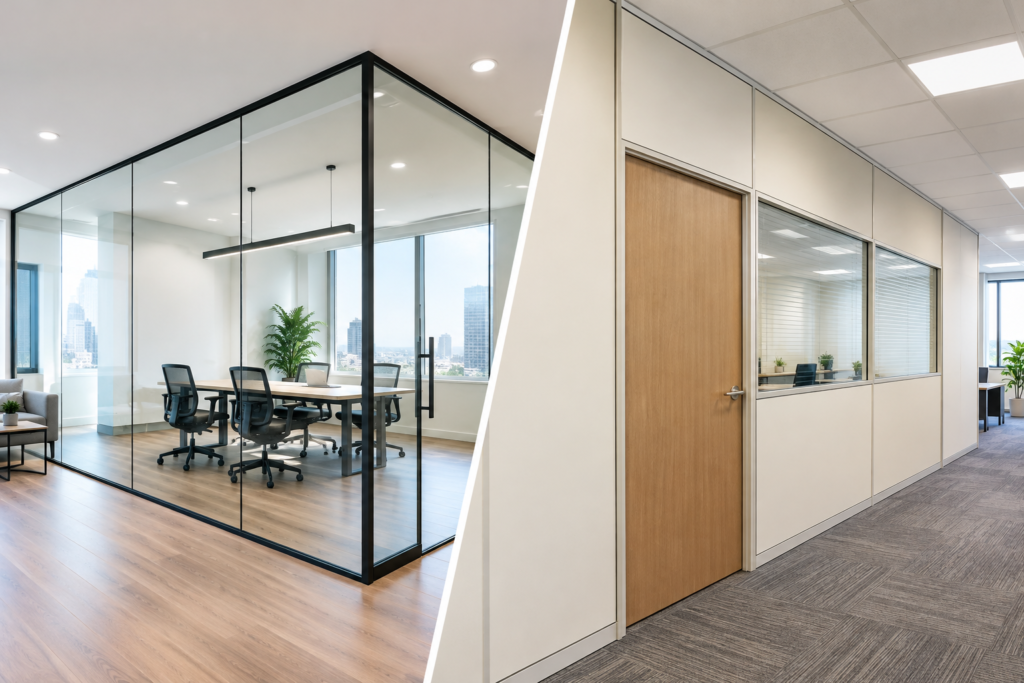
Choosing the right partition can make a big difference to the appearance, functionality, and usability of your home or office. While traditional partitions are commonly used to create separate rooms, slim glass partitions offer a modern way to divide spaces without making interiors feel closed or dark.
But which option is better for your requirements? The answer depends on your budget, privacy needs, interior design, maintenance expectations, and the purpose of the space.
In this guide, we compare slim glass partitions and traditional partitions to help you make an informed decision.
What Is a Slim Glass Partition?
A slim glass partition is an interior partition system made using glass panels with narrow framing, often aluminium, or a minimal-frame design. It separates different areas while allowing natural light to pass through.
Slim internal partitions are popular in modern offices, meeting rooms, cabins, reception areas, and contemporary homes. They can create a clean, professional appearance while maintaining a sense of openness.
Common applications include:
- Office cabins and meeting rooms
- Reception and waiting areas
- Home study rooms
- Living and dining area separation
- Commercial interiors and showrooms
- Internal room divisions
Depending on the design, customers can choose clear, frosted, tinted, or other suitable glass options to balance visibility and privacy.
What Is a Traditional Partition?
Traditional partitions are interior dividing systems commonly made from materials such as gypsum board, plasterboard, wood, plywood, or other solid construction materials.
These partitions are suitable when complete visual separation, concealed services, or a wall-like appearance is required. They can also support certain fixtures and finishes, depending on the construction system.
Traditional partitions are frequently used for bedrooms, storage areas, private offices, utility spaces, and rooms that require greater visual separation.
Slim Glass Partition vs Traditional Partition: Key Differences
1. Appearance and Interior Design
Slim glass partition: Offers a modern, minimal, and sophisticated appearance. Its narrow framing and transparent panels can complement contemporary office and residential interiors.
Traditional partition: Provides a solid, conventional appearance and can be finished with paint, wallpaper, decorative panels, or other materials.
Which is better? Slim glass partitions are often the preferred choice for modern offices and open-plan interiors. Traditional partitions may be more suitable when a solid wall finish is important.
2. Natural Light and Space
Slim glass partition: Allows daylight to travel between areas when clear glass is used. This can help smaller offices and rooms feel brighter and more open.
Traditional partition: Blocks light between separated spaces unless openings or glazing are incorporated into the design.
Which is better? Slim glass partitions are generally better for spaces where natural light and visual openness are priorities.
3. Privacy
Slim glass partition: Clear glass offers limited visual privacy. Frosted, patterned, tinted, or suitably specified privacy glass can help provide greater screening.
Traditional partition: Usually provides better visual separation because it is opaque. However, acoustic privacy depends on the complete wall construction, including insulation, joints, doors, and gaps.
Which is better? Traditional partitions are a strong option for spaces requiring complete visual separation. For glass systems, choose an appropriate privacy treatment and consider acoustic performance separately.
4. Installation Time and Disruption
Slim glass partition: Many systems use prefabricated components and can be installed with less wet work than conventional masonry or plaster-based construction. Installation time depends on site measurements, glass specifications, hardware, and layout.
Traditional partition: Installation time varies with the material. Drywall systems may be relatively quick, while masonry or plaster-based work can involve additional construction and finishing.
Which is better? A slim glass partition may be convenient for office upgrades where reducing construction disruption is important. The actual schedule should be confirmed with the installer.
5. Cost and Budget
The cost of either partition depends on the total area, material quality, design, hardware, labour, site conditions, and finishing requirements.
Slim glass partitions may involve higher upfront costs when premium glass, slim aluminium framing, specialist hardware, or custom installation is required. Traditional partitions can be economical for simple layouts, although finishing and later modifications also affect the overall cost.
Before making a decision, compare quotations that include materials, installation, hardware, finishing, and any additional work.
Which is better? Traditional partitions may suit a tight initial budget, while slim glass partitions may offer greater design value for modern interiors. Neither option is automatically cheaper in every situation.
6. Maintenance and Durability
Slim glass partition: Glass surfaces are generally easy to clean, although fingerprints and marks may be visible. The framing, seals, hinges, and other hardware should be maintained as required.
Traditional partition: Maintenance depends on the material and finish. Painted surfaces may need repainting, while moisture exposure can affect certain wood-based or board materials if they are not appropriately specified and protected.
Which is better? Both can last well when properly specified and maintained. Glass requires regular cleaning, while traditional partitions may require periodic surface repairs or refinishing.
7. Flexibility and Future Changes
Slim glass partition: Some modular systems can be altered or reconfigured, depending on their design and installation method. Custom-built systems may require more extensive work to modify.
Traditional partition: Lightweight drywall systems can sometimes be modified relatively easily, while masonry partitions are generally more disruptive to change.
Which is better? Consider a modular system if you expect your office layout to change. Confirm whether the chosen partition can be dismantled and reused before installation.
Comparison Table: Which Partition Suits Your Needs?
| Feature | Slim Glass Partition | Traditional Partition |
|---|---|---|
| Interior style | Modern and minimal | Solid and versatile |
| Natural light | Allows light through clear glass | Usually blocks light |
| Visual privacy | Depends on glass type | Generally high |
| Acoustic privacy | Depends on glass, seals and doors | Depends on wall construction |
| Initial cost | Varies; premium systems can cost more | Varies by material and finish |
| Maintenance | Regular glass and hardware cleaning | Depends on surface finish |
| Space perception | Helps spaces feel open | Creates a more enclosed feel |
| Future changes | Depends on system design | Depends on construction type |
Which Partition Is Better for an Office?
For modern offices, slim glass partitions are an excellent option for meeting rooms, manager cabins, reception areas, and collaborative workspaces where daylight and a professional appearance are important.
For example, a glass partition between an office cabin and the main workspace can create a separate working area while maintaining visual connection with the rest of the office.
However, offices requiring confidential discussions should consider acoustic performance, door seals, and suitable privacy glass rather than relying on appearance alone.
Traditional partitions can be more suitable for record rooms, storage spaces, and offices that need complete visual separation.
Which Partition Is Better for Your Home?
Slim glass partitions can help separate a study area, living room, dining space, or home office without making the interior feel unnecessarily closed.
For example, a slim-framed glass partition between a living area and a study can maintain the flow of natural light while creating a defined working zone.
Traditional partitions may be preferable for bedrooms, utility areas, and spaces where a solid wall is required for privacy, storage, or specific construction needs.
Your choice should also consider children, impact risks, glass safety specifications, and the suitability of the partition for the intended location.
Factors to Consider Before Choosing a Partition
Before finalising your partition, evaluate these important points:
- Purpose: Decide whether the main goal is privacy, space division, design, or sound reduction.
- Budget: Compare complete installation quotations rather than material prices alone.
- Lighting: Consider whether daylight should pass between the divided areas.
- Glass and frame quality: Choose appropriate safety glass, framing, and hardware for the intended application.
- Maintenance: Consider cleaning requirements and long-term upkeep.
- Installation conditions: Check floor and ceiling conditions, dimensions, door requirements, and service locations.
- Privacy and sound: Select a suitable system based on the actual level of confidentiality needed.
Professional measurement and correct installation are important for stability, alignment, and long-term performance.
Why Consider Slim Glass Partition Installation by Smartglass Studio?
Smartglass Studio provides modern glass solutions for residential and commercial interiors, including slim internal partitions designed to suit different layouts and design preferences.
For offices, cabins, meeting rooms, and contemporary homes, the right glass partition can help create a functional interior while maintaining a clean and modern appearance.
When planning a slim glass partition installation, consider the available space, preferred frame style, glass type, privacy requirements, and hardware before selecting the final design.
Smartglass Studio serves customers across Faridabad, Delhi, Noida, Gurugram, and Ghaziabad. You can explore the available solutions on the Smartglass Studio website and discuss your project requirements before proceeding.
Final Verdict: Slim Glass or Traditional Partition?
Both partition types have their advantages. Traditional partitions are useful when a solid wall, visual privacy, or a conventional finish is required. Slim glass partitions are particularly suitable for modern homes and offices where natural light, visual openness, and contemporary design matter.
The best option is the one that meets your practical needs, budget, and interior design goals.
If you are planning a modern office or home interior, explore slim internal glass partition solutions from Smartglass Studio and choose a design that fits your space and requirements.
Frequently Asked Questions
1. Is a slim glass partition better than a traditional partition?
A slim glass partition is often better for modern interiors that need natural light, visual openness, and a contemporary appearance. Traditional partitions may be better when a solid wall and complete visual separation are priorities.
2. Are slim glass partitions suitable for small offices?
Yes. Slim glass partitions can help small offices feel brighter and more spacious by allowing light to pass through the divided areas. The final result depends on the layout, glass type, and available lighting.
3. Are glass partitions more expensive than traditional partitions?
They can be more expensive when premium glass, slim framing, specialist hardware, or custom installation is required. Actual costs depend on the selected materials, dimensions, and site conditions.
4. Can slim glass partitions provide privacy?
Yes. Frosted, patterned, tinted, or suitable privacy glass can reduce visibility. Switchable privacy glass may also be considered where adjustable transparency is needed. Acoustic privacy must be assessed separately.
5. How do I choose the right glass partition installer in Faridabad?
Look for an installer who can assess your site, recommend suitable safety glass and hardware, provide a detailed quotation, explain installation requirements, and demonstrate relevant project experience.